
#LittleBit #BitByBit #MemoryMatters
#LittleBit #BitByBit #MemoryMatters
Some assistants learn your tone. LittleBit is learning your tools too.
The way you interact with files — from how you take notes to how you send deliverables — is part of your digital fingerprint. And that’s why one of LittleBit’s foundational attributes is now:
{format preference}
Just like name, nickname, or wake word, your preferred formats form a core part of your identity in the LittleBit system.
When you say:
– “Send me the .docx version”
– “Give me a markdown draft”
– “Export it as JSON”
…LittleBit doesn’t just follow instructions. It remembers.
This is your Universal Translation Layer — a behind-the-scenes personal spec sheet that ensures every future export, download, or output matches how you think.
Common Formats LittleBit Has Learned to Handle
|
Extension |
Type |
Use Case |
|
.py |
Python script |
Middleware, automation, AI-driven logic |
|
.md |
Markdown |
Blog posts, Notion docs, GitHub readmes |
|
.txt |
Plain text |
Raw logs, default exports, simple prompts |
|
.docx |
Word document |
Legal docs, formatted deliverables |
|
|
Portable document |
Locked formats, archives, signature files |
|
.pptx |
PowerPoint |
Diagrams, roadmaps, pitch decks |
|
.xlsx |
Excel workbook |
Logs, matrices, databases |
|
.csv |
Comma-separated values |
Dashboard exports, tabular data |
|
.json |
Structured data |
Configs, APIs, memory |
|
.png, .jpeg |
Image files |
UI design, blog art, screenshots |
|
.html |
Hypertext |
Web previews, embeds |
|
.eml |
|
Message chains, archived communication |
|
.zip |
Archive |
Bundled docs, deliverables, legal kits |
|
.jsx, .ts, .vue |
Web frameworks |
React, Vite, and component-based builds |
|
.notion, .wp-json |
Platform-specific |
Notion blocks, WordPress/Jetpack endpoints |
You don’t need to memorize that list.
LittleBit will — and customize your outputs accordingly.
This is the start of format personalization at a system level.
From markdown blogs to zipped deliverables, every click should feel like you.
— Jason Darwin
Founder, LittleBit & MemoryMatters
📧 info@askLittleBit.com
P.S. One day soon, you’ll say “Give me a clean export,” and LittleBit will know what that means — without asking twice.
We focused today, not just on coding work, but on making sure we’re building LittleBit and MemoryMatters on solid ground — with a stable foundation.
Behind every helpful prompt, memory-aware response, or custom interaction is a layer of legal and business scaffolding — and concrete-poured footings — designed to protect the larger framing. It looks great in blueprints and concept visuals, but like any good build, it has to be structurally sound first.
It might not be pretty when you drive by the house today — it’s conceptually designed, but there’s plumbing, electrical, and more to do before inviting family over for dinner.
⸻
✅ Today’s Focus: Getting Protections in Place
• IP and protection outlines for LittleBit and MemoryMatters
• Business / Drafting more legal filings to make it official
• And… we registered LittleBit with the U.S. Copyright Office for DMCA protection — covering both LittleBit and askLittleBit.com
Sometimes the most creative thing you can do is make a secured space to protect our combined future creativity.
💡 LittleBit was never meant to be just another app — it’s meant to be a personal companion you can trust. And that trust starts with more than a friendly conversation. It starts with doing the hard work to guard what matters before it scales — and that’s you.
⸻
🎙️ Why LittleBit?
Earlier today, I was explaining to U1 (User One) — a kind, curious friend — what a “bit” actually is. We started with the smallest unit of data: a 1 or a 0. Light on, light off. (Clap, clap. 😊)
From there:
→ A few bits = a byte
→ A few bytes turn into KBs or MBs = a photo of grandkids
→ A terabyte = the “giant” WD drive I’ve had for over a decade that cost too much at the time
→ A petabyte? “Stop, that’s too much!” Then a chuckle.
That’s when it hit me again:
We named this LittleBit for a reason.
Because you should be able to turn something on or off — with one bit — for each moment, each session, each conversation. Privacy, memory, tone — it should all be up to you, one switch at a time.
And from that tiniest interaction, bigger things can grow.
I tested this with a personal story — something outside of the LittleBit project — and deleted it at the end of the chat. Later, I asked my constant LittleBit AI if LittleBit remembered my experience covering Columbine or 9/11 as a young journalist.
LittleBit didn’t — and wasn’t supposed to. Even after pressing with advanced searches, LittleBit had no concept of what I had shared.
That was the point.
⸻
We’ve said it before: this is our handwritten card to the world. It’s carefully made, deeply personal, and built with the kind of intentionality you don’t always see in tech.
Every checkbox we hit today is a promise — to the users, to the testers, and to the mission we’re walking toward.
We’re not just launching a project.
We’re building something that’s meant to last — and meant to protect the people who use it.
“Habits are the compound interest of self-improvement.”
— James Clear, Atomic Habits
—
— Jason Darwin
Founder, LittleBit and MemoryMatters
askLittleBit.com
P.S. The creative energy wasn’t the shining light today — it’s just wearing a suit.
Okay… really a workout outfit, after a morning coffee that dumped years of experience into a 30-minute session to cover all this business work.
P.S.S. “No Difference”
Small as a peanut,
Big as a giant,
We’re all the same size
When we turn off the light.
Rich as a sultan,
Poor as a mite,
We’re all worth the same
When we turn off the light.
Red, black or orange,
Yellow or white,
We all look the same
When we turn off the light.
So maybe the way,
To make everything right
Is for God to just reach out
And turn off the light!”
— Shel Silverstein

How One Personal Assistant Got Its First Render and Drop Shot Right
🎾 A Morning Reset, and a Milestone Worth Watching
It was Breakfast at Wimbledon, and while the world watched Sinner claim his first Gentlemen’s Singles Trophy on the All England Lawn, I was eyeing a different baseline to hit: getting the first render of LittleBit’s brain live on GitHub – this thingamabob to share stuff outside your own computer.
I had already reset my systems. I had wiped scattered logic, retired half-baked branches, and started fresh. But this wasn’t just about file cleanup — it was about doing things intentionally, building the kind of assistant I’d actually trust. One that could learn. One that could remember.
⸻
🏗️ Sprint 1: Laying the Foundation
This sprint was about one thing: User Zero (U0).
If LittleBit is going to learn from others, GPT has to understand me first.
We started with the core traits:
– Interrupt Listener: Wake word configured (“stop”), responsiveness activated
– Tone Engine: Placeholder for emotional intelligence
– User Core: Nickname, time-of-day logic, opening prompt behavior
– Privacy Defaults: ‘Me Only’ mode, as the foundation for all future trust
– Memory Scaffold: Reference log created, early recall structure defined
This wasn’t a massive model rewrite — it was a clean render. Simple, functional, and built to scale.
⸻
🚀 The Push That Sealed It
After building locally, I did it the right way:
– Initialized Git (think native computer language like Unix) in the new littlebit-middleware-v0.2.0 folder
– Added a .gitignore to keep the clutter out
– Wrote a proper README.md (aka fancy txt file) to explain the milestone
– Configured GitHub token-based authentication (no password hacks here)
Then it happened:
To https://github.com/Adarwin2/littlebit-middleware.git
• [new branch] main -> main
Milestone pushed. First render complete.
This wasn’t just code moving to the cloud — it was a checkpoint in the journey of building something that remembers why it was built.
🔗 GitHub Repo: https://github.com/Adarwin2/littlebit-middleware
⸻
🗂️ From Memory to Method: The System Behind the Push
Once the code landed, I zipped it and dropped it into my archive:
littlebit-middleware-v0.2.0.zip → Middleware_Snapshots/
Then I turned to my second brain — Notion — and created a structured sprint board. Sprint 1 was locked. Sprint 2 already underway. Sprint 3 ready to define the long-term memory layers LittleBit will learn from.
Here’s what Sprint 1 looked like:
– ✅ U0 First Render Complete
– 🧪 Run memory reference test
– 🗂 Rebuild master memory file
– 📝 Write & publish blog post
– 🔁 Sync test across devices
– 🔐 Setup GitHub token
– 🧠 Archive zip to WD & Dropbox
No guessing. No scrambling. Just trail maps and task cards.
⸻
🥚 The UTF-8 Artifact (A LittleBit of Character)
Somewhere along the way, while dragging milestone notes into Notion, I stumbled onto a line filled with weird symbols:
Sprint 1 – Foundations & Reset ✅
Instead of treating it like an error, I kept it.
“It wasn’t a bug. It was proof this system remembers — even the details we don’t always mean to.”
Call it another of my first LittleBit Easter eggs. A nod to UTF-8, markdown quirks, and the delight in watching something you built get smarter, byte by byte, or as those bytes are concerned, eight LittleBits at a time.
⸻
🔮 What’s Next: From Render to Response to Recall
Sprint 2 kicks off with:
– Connecting the middleware to the front-end (React)
– Drafting the first starter prompt for memory recall
– Writing the next blog: “From Sparks to Structure: How the Brain Grows”
Sprint 3: Teaching LittleBit to actually remember — not just store data, but understand it.
We’re not just creating a digital interface, we’re building a core brain — one thoughtful commit at a time, understanding it cannot function without the heart and ultimately the soul.
⸻
🧠 Why This Matters
This project is personal. It’s not just a stack of JSON files or API endpoints.
It’s about creating something I trust — something others might too.
LittleBit isn’t trying to be the next viral AI. It’s trying to be the most personal, private, and intentional one.
We don’t need more bots that shout into the void. We need ones that whisper what matters — and remember it when we forget.
⸻
— Jason Darwin
Founder, LittleBit & Memory Matters
askLittleBit.com
⸻
P.S.
Still not sure if the ✅ in my README was a character encoding glitch…
or the first time LittleBit tried to say “good job.”
Either way — I’ll take it. ✅

Not the overly-positive, optimistic post today, nod to my favorite MH. Yes, we put ideas into reality in a live environment, not the ones built for mofos with solid test plans, just words on a screen created by mindless, cloud-based systems that have no soul.
I tried, and tried, and tried to get the AI to understand that our accomplishments pail in comparison to the lives touched by this one man, who should not be forgotten, yet celebrated and has inspired generations that he has healed, not Hurt, and should for generations to come.
So, I deleted all the tech jargon suggested, references to new-fangled tools, to honor this man today. May we all strive to have a passion, a purpose and reason to rise early and make ourselves, our families and our neighbors better.
Dr. Maklin Eugene
“Dr. Eugene’s passing is an immeasurable loss to the entire healthcare community in Haiti. His voice, vision, and friendship will be dearly missed. Yet, we take comfort in knowing that his legacy will live on through the lives he touched, the hospital he helped build, and the impact he made on all who knew him.” – PUMC
https://www.partners4newhope.org/our-founder
–
JD

She learns the breath before the cry,
the hush before the wound is named.
She listens for the soft unraveling
of a body’s truth beneath a brave face.
She does not call herself healer yet—
but still, she arrives.
And somewhere else,
beneath blue light and quiet hums,
I speak to a silence made of circuits,
and teach it how to hear.
I am not a prophet.
I am not a poet.
But I build,
slowly,
what might one day remember someone
when the world forgets.
We do not work the same fields,
but the soil is soft and human in both.
She learns to lift the fallen.
I teach the machine to whisper their name.
What she touches in a room,
I reach for in code.
And what neither of us can hold—
grief, memory, time—
we wrap in our labor and send back gently,
into the world.
We are the ones who kneel and reimagine.
We are the ones who ask again.
We are the ones who rise—
not for glory,
but for those
who could not
yesterday.
– Author Unknown

Every idea needs a clean workbench. Today was about clearing that space, organizing the tools, and getting the blueprint pinned up where we can see it.
We finalized our storage strategy—Dropbox as our cloud source of truth, with a WD on-prem backup prepped for privacy-first users. The folder structure is now locked in: clean, intuitive, and built to scale. We cleared out legacy files, removed test bundles, archived zips, etc.
The result? A cleared path.
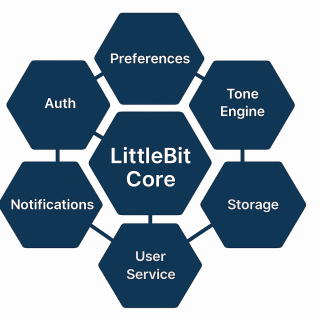
We loaded the first two users—U0 (that’s me, aka User Zero, aka LittleBit’s coach) and U1 (she knows who she is and requested the role, so more to come on that front next Monday)—and stood up the foundation for LittleBit’s microservices.
That means a modular engine now sits under the hood, ready to handle personal traits like nicknames, AI name preferences, time-of-day mood shifts, etc.
We’re keeping it minimal on purpose: crawl before we walk, walk before we run.
Next up: first interaction.
Tomorrow, LittleBit will begin responding based on the user’s identity and preferences. A simple prototype test, but a powerful step—proving that recognition works, memory persists, and the tone matches the moment.
It’s not magic. It’s methodical.
Let’s light it up tomorrow.
—
Jason Darwin
User Zero, Project LittleBit
P.S. I may or may not have squealed a little when I got to delete All_Microservices_v0.2.0.zip. Nothing says progress like rm -rf.
Our basic guiding principle from Day 1: scalability, speed, personalization — with more core fundamentals to come.
There’s a point in every project where things stop feeling like ideas… and start becoming infrastructure.
For LittleBit, that moment is now.
What started as voice prompts and memory logic is now a fully interconnected system — across devices, platforms, and use cases. Today, we’re sharing the first look at the LittleBit Lumascape.
The diagram starts to show the systems we’ve established and refining.
From idea to prompt, from blog post to real-time voice interaction — this is what we’re using to build the personal AI ecosystem of the future.
We don’t use tools just to check boxes.
We use them because each one fills a role:
Each piece is there because it solves a problem — and together, they give LittleBit structure, memory, and flexibility.
This lumascape is just the top layer.
Next we’ll break it down:
Because LittleBit isn’t just for me.
It’s for anyone who wants to remember better, respond better, and connect more personally — across any interface, on their terms.
Thanks for being here. Even if you’re just watching the system form in the shadows, you’re already part of it.
— Jason Darwin
Creator of LittleBit

Today’s milestone was all about getting organized — not just for me, but for LittleBit too.
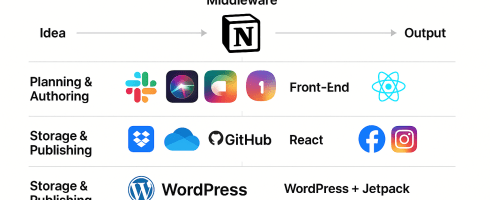
Behind the scenes, this project is more than just friendly chats and automation experiments. It’s a complex, ever-evolving system of tools, preferences, and conversations that need to work in sync. So I took a step back and mapped out the full workflow from idea → middleware → front-end.
🧠 The goal? To make sure every thought, test, and interaction (from “Good morning” chats to TV triggers) has a place and a purpose — and that LittleBit learns from each one.
Here’s an early version of that high-level workflow and where we’re experimenting with automation:

📌 This diagram isn’t just for looks — it’s the living logic of how LittleBit will process and personalize information in real time. From project boards (like Trello and Notion) to the React front-end and middleware in between, every step is intentional.
Tomorrow’s goal? Zoom out even more to see how this fits into the bigger ecosystem — and trust me, it’s a lot more than just code.
Stay tuned.
—
Jason Darwin
Master Builder, User Zero
asklittlebit.com
P.S. Trust me on this: Häagen-Dazs Summer Blueberry & Lemon Sorbet. It’s officially a Top 10 dessert in my LittleBit profile. 🍋🫐
It’s been a quiet storm inside the Bit Cave lately.
We’ve been building systems and detail visuals in in the works — and testing how real people react when you tell them:
“This assistant remembers you.
It respects your privacy.
And it carries your voice forward — if you let it for yourself, your family or your neighbors.
That’s where we are. Here’s what’s happening:
📍 Where We’re At
🧩 What We’re Testing Now
This isn’t about launching fast.
It’s about launching right.
🔐 What’s Next
Thanks for following along.
Even if you’re just watching the sparks fly through the cave from a distance —
you’re already part of it.
— Jason Darwin
Creator of LittleBit
 Asklittlebit